briefs
Topic · across the network

Anarchism

Order without rulers, tested more often than it is credited.

38
briefs
5
subjects
10:04
average
383 min
in total
Abstraction 407Absurdism 137Acoustics 220Acting 65Adaptation 372Addiction 95Adolescence 202Advertising 77Age of exploration 14Ageing 113Agriculture 100Algorithms 114Ambition 46Anarchism 38Ancient Egypt 17Ancient Greece 38Ancient Rome 30Animals 172Anthropology 23Apartheid 12Architecture 165Archives 32Argentina 10Art Deco 26Artificial intelligence 78Astronomy 81Attention 42Australia 32Automation 73Avant-garde 164Aviation 79Banking 72Banned works 40Bauhaus 12Beer 5Behavioural economics 22Berlin 16Big tech 6Biodiversity 136Biography 86Birds 41Black holes 20Blockchain 12Boxing 14Branding 77Brazil 43Bread 29Britain 131Brutalism 4Bubbles 3Buddhism 28Byzantium 10California 17Canada 18Capitalism 94Cars 468Celebrity 59Censorship 110Cheese 24Chefs 9Chemistry 104Chess 2Childhood 87China 109Chocolate 8Christianity 49Cinematography 343Cities 90Class 485Climate change 107Club culture 100Cocktails 2Coffee 11Cognitive bias 14Collecting 16Colonialism 284Colour 42Comedy 89Community 52Complexity 21Computing 309Consciousness 16Conservatism 14Conspiracy theories 8Cooking 178Corruption 38Cosmology 31Cover versions 64Craft 116Crate digging 42Creativity 8Crime 234Cryptocurrency 8Cryptography 24Cuba 10Cybersecurity 30Dada 12Debt 38Decision-making 28Decolonisation 46Deep time 80Democracy 45Denim 16Deserts 45Detroit 17Dinosaurs 12Directing 168Disasters 59Disease 109DJ culture 89Dreams 32Drones 5Drum machines 96Dystopia 69East Africa 28Ecology 337Economics 36Editing 72Education 92Egypt 12Electric vehicles 59Emotion 22Empire 92Endurance 49Energy 120Engineering 541Entropy 8Epidemics 13Equality 9Espionage 31Ethics 44Evolution 174Existentialism 106Expertise 2Exploration 49Extinction 23Failure 37Family 240Fandom 22Fascism 45Fashion 215Fast fashion 12Fear 34Feminism 122Fermentation 126Film music 81Fishing 12Folklore 71Food history 588Football 16Forests 31Forgery 7France 163Fraud 15Free will 13Freedom 16French literature 15Friendship 24Furniture 36Gambling 14Gender 63Generations 28Genetics 87Geology 96Germany 66Globalisation 74Gothic 32Greece 5Grief 126Habits 6Happiness 2Hardware 709Haute couture 22Headphones 8Hi-fi 12Hinduism 12Hoaxes 1Human history 23Human nature 41Identity 138Illustration 8Impressionism 6Improvisation 249India 89Indonesia 15Industrial design 342Inequality 13Inflation 4Information 34Infrastructure 280Insects 29Intelligence 8Interiors 31Internet culture 88Invention 329Iran 41Islam 40Islands 17Israel 9Italy 52Jamaica 10Japan 114Jewellery 5Journalism 34Judaism 13Justice 42Korea 41Language 70Law 90Leadership 20Learning 6Liberalism 1Libraries 6Literary criticism 26London 12Loneliness 61Los Angeles 62Lost works 9Love 67Luxury 55Machine learning 15Management 10Maps 5Marketing 21Markets 51Mars 6Marxism 26Masculinity 46Materials 138Mathematics 79Meaning 6Medicine 124Memory 82Mental health 70Mesopotamia 4Mexico 38Migration 95Minimalism 68Mining 30Misinformation 9Modernism 63Money 24Monopoly 32Mortality 61Motivation 2Mountains 16Museums 27Mysticism 11Mythology 60Nationalism 40Neuroscience 23New York 36Nigeria 7Nihilism 10Noise 31Nostalgia 33Nuclear 29Nutrition 17Oceans 48Oil 42Open source 45Painting 18Palaeontology 29Parenting 14Paris 18Partition 6Patents 71Patronage 14Perception 44Personal style 27Personality 2Persuasion 8Peru 10Philosophy 77Photography 37Physics 206Plants 26Platforms 89Podcasting 1Poetry 25Poland 17Policing 34Pop Art 16Populism 2Portraiture 6Portugal 18Postmodernism 23Power 91Prehistory 24Preservation 28Printmaking 21Privacy 11Probability 6Productivity 1Programming 54Prohibition 1Propaganda 35Protest 75Pseudoscience 17Psychology 80Publishing 22Punishment 16Quantum mechanics 44Race 145Radio 30Railways 35Rave 17Realism 47Record labels 19Recording 810Relativity 23Religion 154Resilience 15Restaurants 30Restoration 2Retail 94Revolution 58Risk 18Ritual 96Robotics 26Romance 96Russia 58Salt 9Sampling 246Satire 84Scandinavia 28Scientific method 186Screenwriting 26Sculpture 7Secularism 2Self-deception 14Semiconductors 73Sexuality 102Ships 18Silence 24Silicon Valley 17Slavery 35Sleep 2Smartphones 27Sneakers 15Social media 58Socialism 9Software 68Songwriting 180Sound design 332Sound systems 20South Africa 19South East Asia 30Space exploration 84Spain 18Special effects 41Spices 62Spirits 12Sport 82Startups 21Statistics 10Status 9Stoicism 4Storytelling 68Strategy 70Street food 99Streetwear 16Studio craft 508Subcultures 59Sugar 12Supply chains 115Surrealism 53Surveillance 21Sustainability 30Synthesis 232Tailoring 37Taxation 14Tea 24Textiles 97Thailand 11The American Revolution 19The American South 88The Arab world 41The Arctic 19The Balkans 17The Belle Epoque 13The body 29The brain 26The Caribbean 28The civil rights movement 62The Cold War 160The eighties 268The Enlightenment 29The financial crisis 19The First World War 39The food industry 157The French Revolution 9The Gilded Age 9The Great Depression 18The Holocaust 20The Industrial Revolution 93The internet 61The interwar years 135The Middle Ages 35The Moon 4The music business 169The Netherlands 10The nineties 26The Olympics 10The pandemic 13The Reformation 1The Renaissance 16The Russian Revolution 19The Second World War 102The seventies 58The sixties 28The space race 5The United States 19The universe 7The Victorian era 37Therapy 20Tokyo 11Trade 48Tragedy 22Translation 5Trauma 85Travel 5True crime 2Turkey 18Typography 54Uniforms 23Unions 8Urban planning 66Utilitarianism 1Utopia 5Vaccines 10Vegetarianism 15Venture capital 6Video games 291Vietnam 12Vintage 65Vinyl 6Virtual reality 11War 169Watches 4Water 11Weather 29West Africa 29Wilderness 10Wine 3Work 22Workwear 19Worldbuilding 121

music.briefs Music

All 9 in music →
11:33

Sandinista!

The Clash · 1980

A 36-song triple LP released in December 1980. The Clash’s fourth studio album. Recorded over most of 1980 across London, Manchester, Jamaica, and New York. Produced by the band — primarily Mick Jones and Joe Strummer — with Mikey Dread’s participation. The only Clash album where all four members perform lead vocals.
9:23

The Raincoats

The Raincoats · 1979

The Raincoats’ 1979 debut is a document of intuition over instruction. Four women — Ana da Silva, Gina Birch, Palmolive, and Vicky Aspinall — recorded it with Mayo Thompson and Geoff Travis, using minimal gear and maximal trust in their own ears. Its sound is ragged, homespun folk-punk: elastic rhythms, reedy vocals, rickety structures. Lora Logic’s saxophone appears once. Ross Crighton’s lyrics for 'Life on the Line' name Ladbroke Grove tube station. Palmolive left before release; Ingrid Weiss replaced her. No myth. Just music made in real time, with what they had.

8:47

Clandestino

Manu Chao · 1998

Clandestino is a document of accidental minimalism — made mobile, made human, made urgent.

9:20

Damaged

Black Flag · 1981

Damaged is not a document of rebellion — it is the sound of a room, a wrist, a decision to record twice and choose the first take of 'Damaged I'. Its power lies in what it leaves unplayed, unsoftened, unexplained.

8:56

Dookie

Green Day · 1994

Dookie is Green Day’s major-label debut, recorded in 1993 across Fantasy Studios in Berkeley and Music Grinder Studio in Hollywood. It was written mostly by Billie Joe Armstrong from personal experience, addressing boredom, anxiety, relationships, and sexuality. The band demoed 'She', 'Sassafras Roots', 'Pulling Teeth', and 'F.O.D.' on Armstrong’s four-track before recording. Rob Cavallo took them to a Mexican restaurant near Fantasy Studios to ease anxiety — even though Tré Cool was underage. Unlike earlier albums rushed to save money, they took time to perfect quality. Armstrong learned to dial in better guitar tones and vocal takes, choosing a 100-watt Marshall Plexi 1959SLP nicknamed 'Pete'. Recording lasted three weeks at Fantasy; the album was mixed twice by Cavallo and Jerry Finn. It was released in February 1994. Its singles 'Longview', 'Basket Case', and 'When I Come Around' all reached number one on the Modern Rock Tracks chart. It won the 1995 Grammy Award for Best Alternative Album.

9:26

Fresh Fruit for Rotting Vegetables

Dead Kennedys · 1980

Fresh Fruit for Rotting Vegetables is a tightly wound, ideologically charged debut that uses minimal means — one drummer, one extra guitarist, sparse keyboards, stacked backing vocals on a single track — to deliver maximum friction. Its sound is stripped, urgent, and unrelenting. Its ideas are specific, prosecutorial, and unapologetic. It does not invite reflection — it demands reaction.

8:35

Rage Against the Machine

Rage Against the Machine · 1992

Rage Against the Machine (1992) is a self-titled debut album built from the band’s own demo tape, released November 1992. It fuses funk and heavy metal, uses no samples, keyboards or synthesizers, and features politically charged lyrics. Produced by Garth Richardson, the core quartet each contributed to production and art direction. Its cover uses Malcolm Browne’s Pulitzer Prize-winning photograph of Thích Quảng Đức’s 1963 self-immolation in Saigon. 'Killing in the Name' — the incendiary lead single — contains only eight lines of lyrics and was accidentally broadcast uncut on BBC Radio 1 in February 1993.

9:36

Spiderland

Slint · 1991

Spiderland is a live-recorded, effects-free document of four musicians playing in a room under pressure—both musical and psychological. Its influence is real, but its power lies in what it refuses: polish, explanation, relief.

film.briefs Film

All 9 in film →
13:00

Baal

Volker Schlöndorff · 1970

Volker Schlöndorff’s 1970 adaptation of Brecht’s Baal transposes the 1923 play into late-1960s West Germany, starring Rainer Werner Fassbinder in the title role. Shot in vivid, expressionistic colour by Dietrich Lohmann and scored sparsely by Klaus Doldinger, it refuses psychological exposition or moral framing. Instead, it holds Baal — a self-destructive, charismatic, violently entitled poet — in unrelenting focus, exposing the social machinery that enables his ‘genius’. Long suppressed and recently restored, it remains a rigorous, uncomfortable, and formally exacting work.

13:00

Babo 73

Robert Downey Sr. · 1964

Babo 73 is a 1964 American underground comedy directed by Robert Downey Sr., presenting a surreal, non-narrative campaign for a fictional presidential candidate named Babo. Shot on 16mm in black and white, it uses repetition, deadpan delivery, and jagged editing to dissect the performative emptiness of political theatre. With no score, minimal dialogue, and no character development, it operates as a formal experiment in anti-rhetoric—less satire than structural diagnosis.

13:00

Jubilee

Derek Jarman · 1978

Derek Jarman’s 1978 Jubilee transplants Queen Elizabeth I into a decaying, punk-saturated 1970s London. Shot on location in Blitz-damaged neighbourhoods, it follows a nihilistic gang—Amyl Nitrate, Bod, Chaos, Crabs and Mad—through acts of violence, commodification and petty rebellion, all observed by Elizabeth, John Dee and Ariel. With Brian Eno’s ambient score and Peter Middleton’s raw cinematography, the film rejects narrative fluency in favour of texture, rupture and mythic collapse. Now a cult classic, it remains a stark, unresolved portrait of national exhaustion.

13:00

Lady Snowblood: Love Song of Vengeance

Toshiya Fujita · 1974

Lady Snowblood: Love Song of Vengeance (1974), directed by Toshiya Fujita, is the second film in the Lady Snowblood series — but a deliberate departure from its manga source and predecessor. Set in late-Meiji Japan, it follows Yuki Kashima (Meiko Kaji) as she infiltrates the household of anarchist Ransui Tokunaga (Jūzō Itami) under orders from the Secret Police. With restrained performances, muted cinematography by Tatsuo Suzuki and Masaki Tamura, and a script that favours implication over exposition, the film explores coercion, ideological uncertainty, and the quiet violence of bureaucratic control. Though structurally uneven and thematically opaque in places, it remains a precise, unsentimental study in moral suspension.

13:00

Multiple Maniacs

John Waters · 1970

Multiple Maniacs (1970), written and directed by John Waters, is a black-and-white 16mm comedy starring Divine and the Dreamland troupe. Set in Baltimore, it follows a perverse carnival’s descent into violence and surreal retribution. Shot, edited, and scored by Waters himself, it rejects narrative logic and technical polish in favour of sustained provocation. Its themes include the performativity of morality, the politics of disgust, and the aesthetics of marginality. Though rated 100% on Rotten Tomatoes, its value lies not in consensus but in its uncompromising coherence as a polemic in film form.

13:00

Slacker

Richard Linklater · 1991

Richard Linklater’s 1991 debut is a loose chain of vignettes following eccentric, under-30 Austinites over a single day. Shot on 16mm with a $23,000 budget, it moves from character to character without resolution, using muted cinematography by Lee Daniel and sparse scoring by Georges Delerue. It rejects traditional narrative in favour of observational density, capturing a mood of intellectual drift and quiet disaffection. Though divisive in pacing and structure, it became a landmark of American arthouse cinema and entered the National Film Registry in 2012.

13:00

Zero for Conduct

Jean Vigo · 1933

Jean Vigo’s Zero for Conduct (1933) is a 44-minute French featurette depicting revolt by four boys against the rigid authority of a boarding school. Shot on a modest budget with non-professional actors, it draws on Vigo’s own childhood experiences and anarchist convictions. Boris Kaufman’s cinematography and Vigo’s editing emphasise physicality and rhythm over exposition, while Maurice Jaubert’s score underscores its insurgent pulse. Banned in France until 1945, it has since influenced Truffaut and Anderson. It is arthouse comedy rooted in pedagogy, surrealism, and resistance.

13:00

Branded to Kill

Seijun Suzuki · 1967

Seijun Suzuki’s 1967 Nikkatsu production is a formally audacious, narratively defiant yakuza film starring Joe Shishido as Goro Hanada, a contract killer whose professional collapse triggers a descent into absurdity. Written collectively as Hachiro Guru and shot in 25 days, it replaces genre conventions with visual non-sequiturs, tonal whiplash and structural sabotage — rice-sniffing fetishes, butterfly interruptions and projected film loops all serve its core project: to make coherence feel like the illusion.

games.briefs Games

All 1 in games →
8:37

Rust (video game)

Facepunch Studios · 2018

Rust is a multiplayer survival game developed and published by Facepunch Studios. It launched in 2018. Players must gather or steal materials to survive in a harsh open world. They manage hunger, thirst, and health. Other players are the primary threat. Combat uses firearms and bows. NPC vehicles occasionally roam and attack armed players. Crafting is initially limited until specific items are discovered. Players build bases or join clans for protection. Raiding is central. The game operates on 'Wipes' that reset progress regularly.

culture.briefs Culture

All 16 in culture →
9:10

Free party

Free parties weren’t just parties—they were jurisdictional strikes.
8:24

Provo (movement)

Provo didn’t protest power—it baited it, filmed it losing, and got the police chief fired.
8:24

Grunge

Grunge didn’t rebel — it withdrew, and got paid for it.
11:13

Squatting

Squatting isn’t protest theatre — it’s the default housing strategy for one billion people, and the law still doesn’t know what to call it.

audio.briefs Audio

All 3 in audio →
7:59

Boss DM-2 Delay

Boss

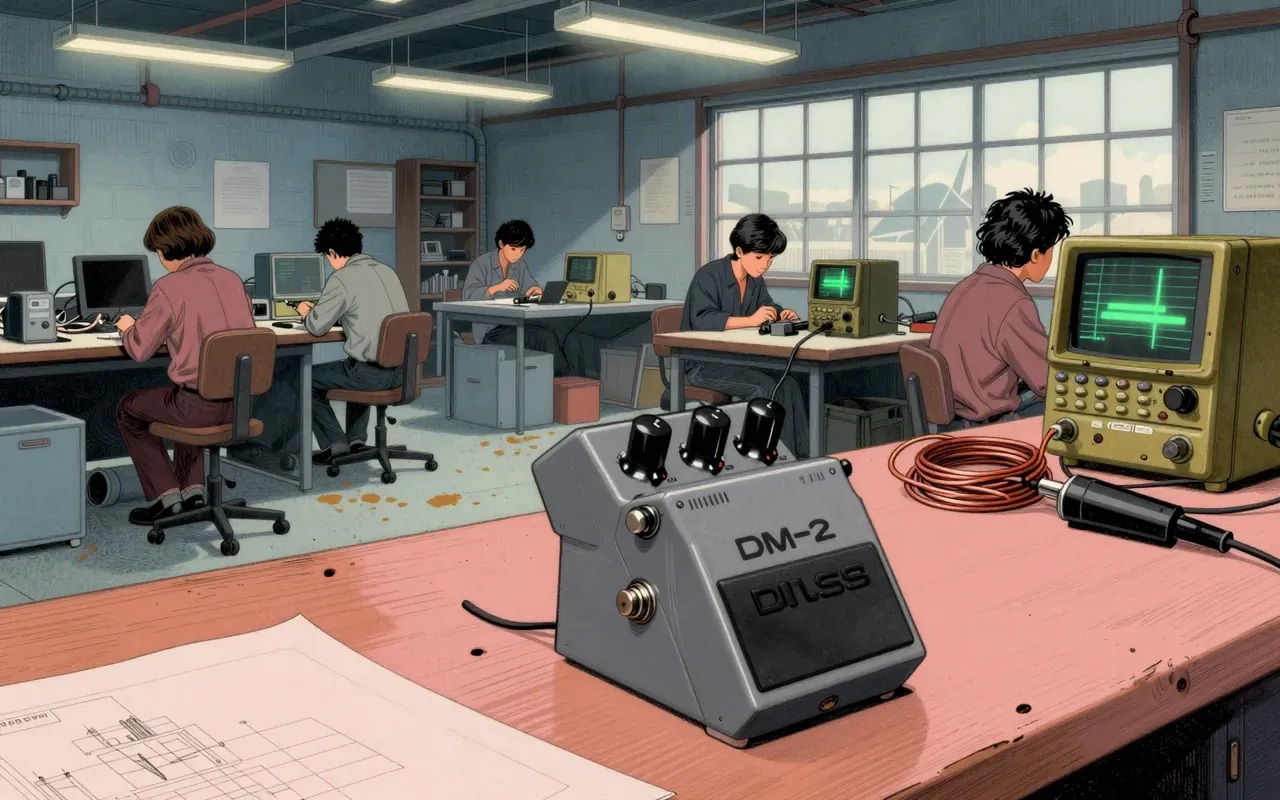
The Boss DM-2 is a Japanese-made analog delay pedal released in 1981. It delivers warm, tone-enhancing repeats from 20ms to 300ms using three knobs: Repeat Rate, Echo, and Intensity. It has no MIDI, no computer control, and is not rackable. It was built for guitar and other electronic instruments. It thickens tone rather than cutting with precision.

9:25

Korg Delta

Korg

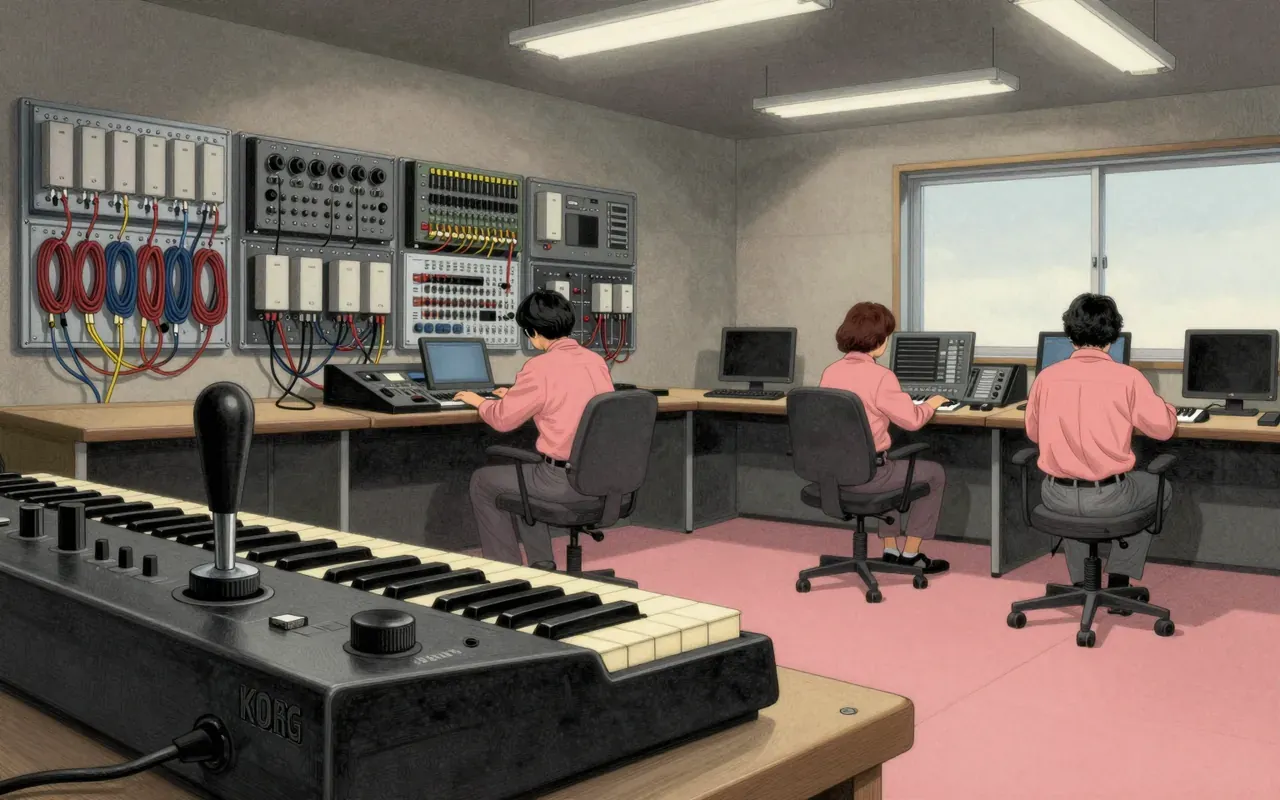
The Korg Delta is a 1979 analog semi-polyphonic string machine and synthesizer. It was built as a slimmed-down, budget alternative to the Korg Trident. It splits into two independent sections—Strings and Synth—with dedicated outputs. The String section uses two pitch sliders and tone/ADSR controls. The Synth section uses four pitch sliders, white noise, a multimode 24dB/oct filter, and full ADSR. A joystick provides pitch bend and modulation. It has CV/gate connectivity but no memory, no MIDI, and no presets. Its 'unlimited polyphony' is inaccurate: pressing multiple keys does not apply independent envelopes to each note. It delivers high-quality layered string-and-synth sounds despite limited range. Its build is robust, but its keyboard is fragile and its filter is bland.

8:29

Roland Jupiter-8

Roland

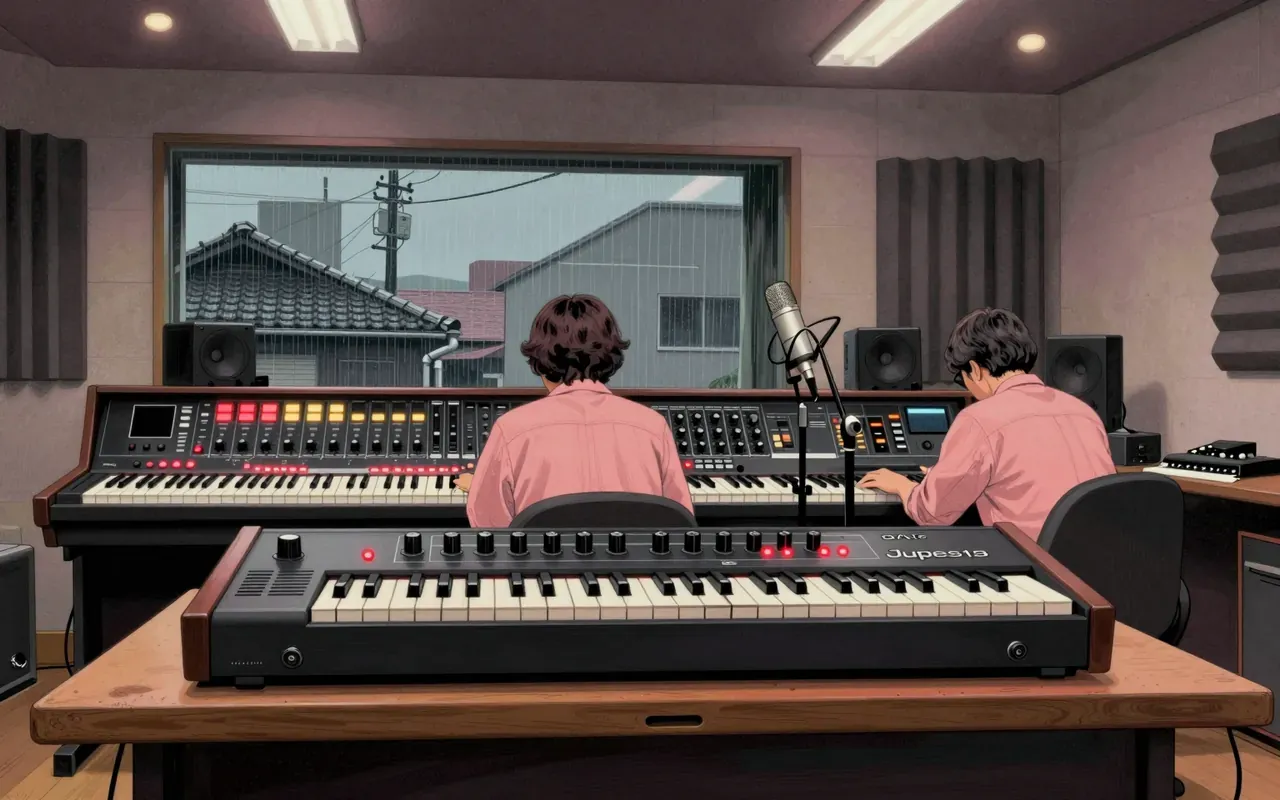
The Jupiter-8 is an eight-voice polyphonic analog subtractive synthesizer introduced by Roland in early 1981. Each voice features two discrete VCOs with cross-modulation and sync, pulse-width modulation, a non-resonant high-pass filter, a resonant low-pass filter with 2-pole and 4-pole settings, an LFO with variable waveforms and routings, and two envelope generators (one invertible). It includes adjustable polyphonic portamento, a hold function for infinite sustain, an assignable bender for pitch or filter frequency, balanced XLR and unbalanced 1/4" outputs for Upper and Lower presets in Split mode, and a unique polyphonic unison mode where all 16 oscillators stack onto one note and divide down when more keys are pressed. Its arpeggiator syncs externally via DCB or CV. Tuning stability improved from serial #171700 onward.