briefs
Topic · across the network

Nuclear

The technology that is both the bomb and the cleanest power available.

29
briefs
8
subjects
11:29
average
333 min
in total
Abstraction 407Absurdism 137Acoustics 220Acting 65Adaptation 372Addiction 95Adolescence 202Advertising 77Age of exploration 14Ageing 113Agriculture 100Algorithms 114Ambition 46Anarchism 38Ancient Egypt 17Ancient Greece 38Ancient Rome 30Animals 172Anthropology 23Apartheid 12Architecture 165Archives 32Argentina 10Art Deco 26Artificial intelligence 78Astronomy 81Attention 42Australia 32Automation 73Avant-garde 164Aviation 79Banking 72Banned works 40Bauhaus 12Beer 5Behavioural economics 22Berlin 16Big tech 6Biodiversity 136Biography 86Birds 41Black holes 20Blockchain 12Boxing 14Branding 77Brazil 43Bread 29Britain 131Brutalism 4Bubbles 3Buddhism 28Byzantium 10California 17Canada 18Capitalism 94Cars 468Celebrity 59Censorship 110Cheese 24Chefs 9Chemistry 104Chess 2Childhood 87China 109Chocolate 8Christianity 49Cinematography 343Cities 90Class 485Climate change 107Club culture 100Cocktails 2Coffee 11Cognitive bias 14Collecting 16Colonialism 284Colour 42Comedy 89Community 52Complexity 21Computing 309Consciousness 16Conservatism 14Conspiracy theories 8Cooking 178Corruption 38Cosmology 31Cover versions 64Craft 116Crate digging 42Creativity 8Crime 234Cryptocurrency 8Cryptography 24Cuba 10Cybersecurity 30Dada 12Debt 38Decision-making 28Decolonisation 46Deep time 80Democracy 45Denim 16Deserts 45Detroit 17Dinosaurs 12Directing 168Disasters 59Disease 109DJ culture 89Dreams 32Drones 5Drum machines 96Dystopia 69East Africa 28Ecology 337Economics 36Editing 72Education 92Egypt 12Electric vehicles 59Emotion 22Empire 92Endurance 49Energy 120Engineering 541Entropy 8Epidemics 13Equality 9Espionage 31Ethics 44Evolution 174Existentialism 106Expertise 2Exploration 49Extinction 23Failure 37Family 240Fandom 22Fascism 45Fashion 215Fast fashion 12Fear 34Feminism 122Fermentation 126Film music 81Fishing 12Folklore 71Food history 588Football 16Forests 31Forgery 7France 163Fraud 15Free will 13Freedom 16French literature 15Friendship 24Furniture 36Gambling 14Gender 63Generations 28Genetics 87Geology 96Germany 66Globalisation 74Gothic 32Greece 5Grief 126Habits 6Happiness 2Hardware 709Haute couture 22Headphones 8Hi-fi 12Hinduism 12Hoaxes 1Human history 23Human nature 41Identity 138Illustration 8Impressionism 6Improvisation 249India 89Indonesia 15Industrial design 342Inequality 13Inflation 4Information 34Infrastructure 280Insects 29Intelligence 8Interiors 31Internet culture 88Invention 329Iran 41Islam 40Islands 17Israel 9Italy 52Jamaica 10Japan 114Jewellery 5Journalism 34Judaism 13Justice 42Korea 41Language 70Law 90Leadership 20Learning 6Liberalism 1Libraries 6Literary criticism 26London 12Loneliness 61Los Angeles 62Lost works 9Love 67Luxury 55Machine learning 15Management 10Maps 5Marketing 21Markets 51Mars 6Marxism 26Masculinity 46Materials 138Mathematics 79Meaning 6Medicine 124Memory 82Mental health 70Mesopotamia 4Mexico 38Migration 95Minimalism 68Mining 30Misinformation 9Modernism 63Money 24Monopoly 32Mortality 61Motivation 2Mountains 16Museums 27Mysticism 11Mythology 60Nationalism 40Neuroscience 23New York 36Nigeria 7Nihilism 10Noise 31Nostalgia 33Nuclear 29Nutrition 17Oceans 48Oil 42Open source 45Painting 18Palaeontology 29Parenting 14Paris 18Partition 6Patents 71Patronage 14Perception 44Personal style 27Personality 2Persuasion 8Peru 10Philosophy 77Photography 37Physics 206Plants 26Platforms 89Podcasting 1Poetry 25Poland 17Policing 34Pop Art 16Populism 2Portraiture 6Portugal 18Postmodernism 23Power 91Prehistory 24Preservation 28Printmaking 21Privacy 11Probability 6Productivity 1Programming 54Prohibition 1Propaganda 35Protest 75Pseudoscience 17Psychology 80Publishing 22Punishment 16Quantum mechanics 44Race 145Radio 30Railways 35Rave 17Realism 47Record labels 19Recording 810Relativity 23Religion 154Resilience 15Restaurants 30Restoration 2Retail 94Revolution 58Risk 18Ritual 96Robotics 26Romance 96Russia 58Salt 9Sampling 246Satire 84Scandinavia 28Scientific method 186Screenwriting 26Sculpture 7Secularism 2Self-deception 14Semiconductors 73Sexuality 102Ships 18Silence 24Silicon Valley 17Slavery 35Sleep 2Smartphones 27Sneakers 15Social media 58Socialism 9Software 68Songwriting 180Sound design 332Sound systems 20South Africa 19South East Asia 30Space exploration 84Spain 18Special effects 41Spices 62Spirits 12Sport 82Startups 21Statistics 10Status 9Stoicism 4Storytelling 68Strategy 70Street food 99Streetwear 16Studio craft 508Subcultures 59Sugar 12Supply chains 115Surrealism 53Surveillance 21Sustainability 30Synthesis 232Tailoring 37Taxation 14Tea 24Textiles 97Thailand 11The American Revolution 19The American South 88The Arab world 41The Arctic 19The Balkans 17The Belle Epoque 13The body 29The brain 26The Caribbean 28The civil rights movement 62The Cold War 160The eighties 268The Enlightenment 29The financial crisis 19The First World War 39The food industry 157The French Revolution 9The Gilded Age 9The Great Depression 18The Holocaust 20The Industrial Revolution 93The internet 61The interwar years 135The Middle Ages 35The Moon 4The music business 169The Netherlands 10The nineties 26The Olympics 10The pandemic 13The Reformation 1The Renaissance 16The Russian Revolution 19The Second World War 102The seventies 58The sixties 28The space race 5The United States 19The universe 7The Victorian era 37Therapy 20Tokyo 11Trade 48Tragedy 22Translation 5Trauma 85Travel 5True crime 2Turkey 18Typography 54Uniforms 23Unions 8Urban planning 66Utilitarianism 1Utopia 5Vaccines 10Vegetarianism 15Venture capital 6Video games 291Vietnam 12Vintage 65Vinyl 6Virtual reality 11War 169Watches 4Water 11Weather 29West Africa 29Wilderness 10Wine 3Work 22Workwear 19Worldbuilding 121

film.briefs Film

All 4 in film →
13:00

Fail-Safe

Sidney Lumet · 1964

A US bomber squadron, accidentally released from fail-safe protocols, heads toward Moscow. With no way to recall them, the President must order the destruction of New York City to prove to the Soviets that the attack was accidental — not the opening move of a first strike. Sidney Lumet’s 1964 thriller unfolds in real time across war rooms and airborne command posts, using austere visuals, procedural dialogue, and Henry Fonda’s restrained performance to dramatise how rational systems produce irrational ends.
13:00

Genocide

Kazui Nihonmatsu · 1968

Genocide (1968), directed by Kazui Nihonmatsu for Shochiku, is a science fiction horror film set on a fictional Japanese archipelago where weaponised insects emerge in the wake of a crashed H-bomb. Blending Cold War paranoia, post-nuclear trauma, and ecological unease, it follows biologist Dr. Nagumo, islander Yukari, and American soldiers as they confront biological invasion, espionage, and the looming threat of nuclear cover-up. Shot by Shizuo Hirase with a sparse score by Shunsuke Kikuchi, it is austere in execution and ambitious in theme — Shochiku’s final horror release, and a singularly uneasy artefact of its time.

13:00

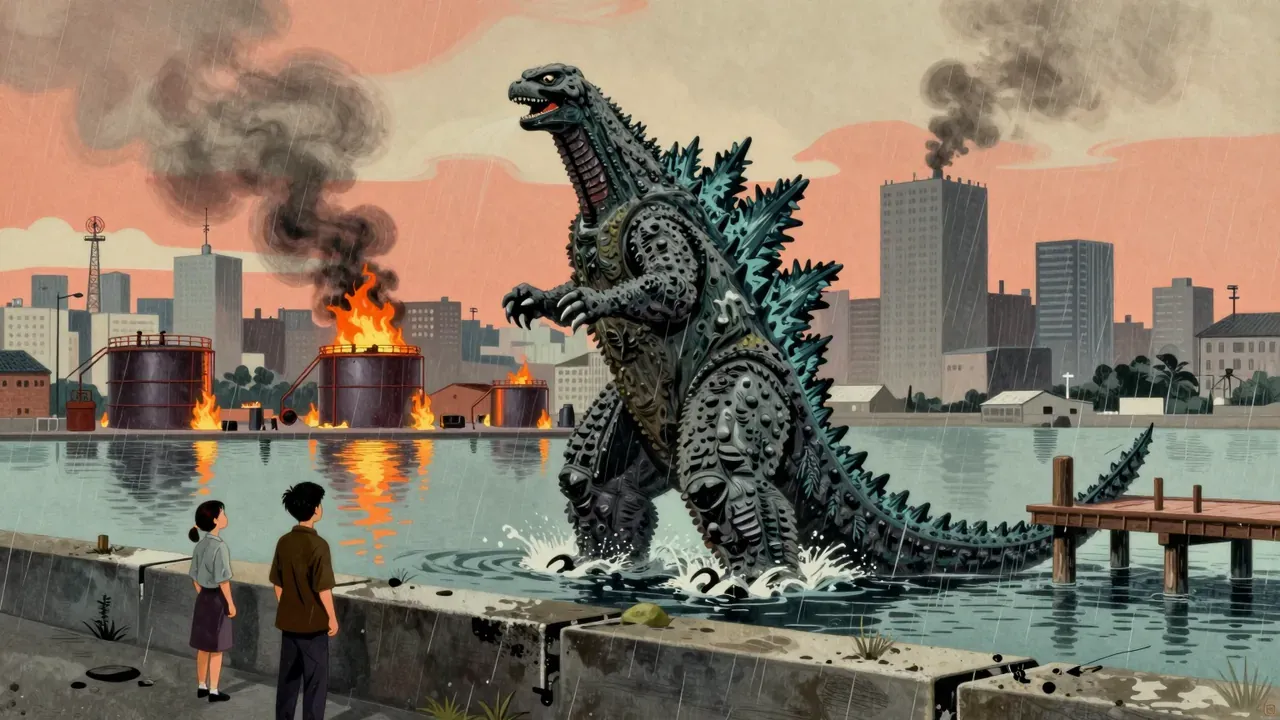
Godzilla

Ishirō Honda · 1954

Godzilla (1954) is Toho’s foundational kaiju film, directed by Ishirō Honda and conceived after the Daigo Fukuryū Maru incident. It follows scientists and officials responding to a prehistoric creature mutated by hydrogen bomb tests. Shot in black-and-white with pioneering suitmation effects, its tone is sober, almost documentary-like. The film avoids monster-movie tropes in favour of bureaucratic realism, scientific debate, and quiet devastation. Though its pacing and formal restraint challenge modern expectations, its thematic urgency — on nuclear consequence, institutional failure, and irreversible change — remains undimmed.

13:00

The Atomic Submarine

Spencer Gordon Bennet · 1959

The Atomic Submarine (1959) is a low-budget American sci-fi film following the USS Tigershark as it hunts an extraterrestrial underwater saucer near the North Pole. Directed by Spencer Gordon Bennet and written by Orville H. Hampton, it centres on a moral and tactical clash between a career submariner and a pacifist scientist, culminating in a biologically grounded alien threat and a technically inventive resolution. Shot in six days with stock footage and minimal sets, it prioritises conceptual cohesion over visual grandeur.

history.briefs History

All 10 in history →
11:49

Atomic bombings of Hiroshima and Nagasaki

6 and 9 August 1945

The atomic bombings of Hiroshima and Nagasaki were deliberate, authorised, and executed military operations using newly developed nuclear weapons. Their scale, method, and human impact are well-documented in the source. Their causal relationship to Japan’s surrender is asserted only as ‘precipitation’—not proof of necessity or sufficiency. No claim about motives, alternatives, or internal Japanese decision-making appears in the material.

11:46

Chernobyl disaster

26 April 1986

The Chernobyl disaster was a cascade of physical failures triggered by a safety test conducted under unstable conditions — not human error alone, but design flaws made manifest. The Soviet state responded with delay, staging and silence until external detection compelled admission. The record establishes sequence, scale and official action — nothing more.

11:12

Potsdam Conference

17 July to 2 August 1945

The Potsdam Conference was a tightly bounded, procedurally self-conscious effort to manage postwar Germany — not to end the war (that had happened), nor to build peace (no treaties were signed), nor to reconcile allies (disagreements are unrecorded). Its significance lies in its method: scheduled, interrupted, adaptive, and shadowed by a weapon no one named aloud.

11:35

Three Mile Island accident

March 28, 1979

The Three Mile Island accident was a partial nuclear meltdown of the TMI-2 reactor beginning at 4:00 a.m. on March 28, 1979, releasing radioactive gases and iodine; it is rated Level 5 on the International Nuclear Event Scale and remains the worst U.S. commercial nuclear power plant accident. The event originated in the non-nuclear secondary system and involved a stuck-open pilot-operated relief valve causing coolant loss, compounded by operator failure to recognize a loss-of-coolant accident due to inadequate training and procedures.

13:00

Hiroshima

6 August 1945

Founded as a castle town in 1589, Hiroshima grew into a regional military and industrial centre before the United States dropped an atomic bomb on it on 6 August 1945. Immediate deaths ran into the tens of thousands, with the toll continuing to climb from injury and radiation for months afterward, and occupation censorship kept much of the detail from the Japanese public for years. The rebuilt city has since made remembrance its civic purpose, formalised as a City of Peace in 1949.

13:00

2011 Tōhoku earthquake and tsunami

11 March 2011

The magnitude 9.0 to 9.1 earthquake that struck off Japan's Oshika Peninsula on 11 March 2011 was the most powerful ever recorded in the country, generating tsunami waves as high as 40.5 metres that reached ten kilometres inland and killed close to twenty thousand people. Total damage exceeded three hundred billion dollars, making it the costliest natural disaster in recorded history even before accounting for the Fukushima Daiichi nuclear accident the tsunami triggered. The earthquake shifted Honshu by 2.4 metres, generated more than thirteen thousand aftershocks, and measurably altered the length of Earth's day, prompting a fundamental rethinking of Japan's disaster prevention policy afterward.

13:00

Cold War

1945–1991

The Cold War ran from roughly 1947 to the Soviet Union's dissolution in December 1991, pitting the United States and its allies against the Soviet Union and the communist bloc. It never produced direct combat between the two superpowers but shaped proxy wars in Korea, Vietnam and elsewhere, an arms race, and a divided Europe, and historians still disagree over how much blame for its outbreak belongs to Soviet expansion versus American containment policy.

13:00

Cuban Missile Crisis

14 October – 28 October 1962

The Cuban Missile Crisis unfolded between 16 and 28 October 1962, after American reconnaissance confirmed Soviet nuclear missiles being installed in Cuba. President Kennedy's administration responded with a naval blockade rather than the invasion his military advisers preferred, and the crisis ended with a negotiated withdrawal that included a secret, unpublicised American concession over missiles in Turkey. It is remembered as the closest the Cold War came to direct nuclear conflict.

science.briefs Science

All 7 in science →
11:02

Nuclear fusion

Fusion was solved for stars in 1939—not for power plants, and not by engineers.
13:00

Stellar nucleosynthesis

Bethe's 1939 theory of how stars fuse hydrogen waited 81 years for direct confirmation, arriving only in 2020 when a neutrino detector finally caught the CNO cycle operating inside the Sun itself.
10:18

Chicago Pile-1

Enrico Fermi

Chicago Pile-1 proved a self-sustaining nuclear chain reaction was possible using natural uranium and purified graphite — nothing more, nothing less.

10:25

Enrico Fermi

Fermi didn’t discover new elements — he discovered how to split atoms, then misread the evidence.
13:00

Nuclear fission

Otto Hahn's puzzling 1938 chemistry, barium from bombarded uranium, was explained within weeks by the exiled Lise Meitner and Otto Frisch as nuclear fission, work for which only Hahn received the 1944 Nobel Prize.
10:08

J. Robert Oppenheimer

Oppenheimer didn’t build bombs — he built the mathematical scaffolding for quantum chemistry, nuclear physics, and black holes.
13:00

National Ignition Facility

The National Ignition Facility's December 2022 shot produced more fusion energy than its laser delivered to the fuel, a real milestone at the target that is roughly a hundredfold short of net energy for the facility itself.

games.briefs Games

All 1 in games →
9:59

Metal Gear Solid (video game)

Hideo Kojima / Konami · 1998

A top-down stealth action-adventure set inside a nuclear weapons facility, where players control Solid Snake to infiltrate, evade, and acquire key cards from bosses while managing shifting threat states: infiltration, alert, and evasion.

business.briefs Business

All 1 in business →
10:02

Exelon

Biggest isn’t safest — Exelon’s scale came from mergers, not reliability.

technology.briefs Technology

All 3 in technology →
8:36

Nuclear power

Nuclear power delivers low-carbon baseload electricity—but only by accepting high cost, slow deployment, and unresolved waste.
9:39

Nuclear reactor

Enrico Fermi

Chicago Pile-1 was not a power plant. It was a proof-of-concept pile — physically crude, operationally minimal, and militarily urgent. Its success established that controlled fission was possible. Its limitations — no heat extraction, no radiation shielding, no control rods beyond cadmium-coated wood — show how far engineering lagged behind theory.

culture.briefs Culture

All 2 in culture →
9:42

Homi J. Bhabha

He didn’t build bombs—he built the machines that decided whether India would have them.
8:58

Fan service

Fan service is not indulgence — it is narrative surrender to audience demand.

fashion.briefs Fashion

All 1 in fashion →
9:36

Bikini

A swimsuit named after a nuclear test—and worn without irony by the mid-1960s.