briefs
Topic · across the network

Democracy

Rule by the ruled, in whichever diluted form is currently available.

45
briefs
6
subjects
11:09
average
501 min
in total
Abstraction 407Absurdism 137Acoustics 220Acting 65Adaptation 372Addiction 95Adolescence 202Advertising 77Age of exploration 14Ageing 113Agriculture 100Algorithms 114Ambition 46Anarchism 38Ancient Egypt 17Ancient Greece 38Ancient Rome 30Animals 172Anthropology 23Apartheid 12Architecture 165Archives 32Argentina 10Art Deco 26Artificial intelligence 78Astronomy 81Attention 42Australia 32Automation 73Avant-garde 164Aviation 79Banking 72Banned works 40Bauhaus 12Beer 5Behavioural economics 22Berlin 16Big tech 6Biodiversity 136Biography 86Birds 41Black holes 20Blockchain 12Boxing 14Branding 77Brazil 43Bread 29Britain 131Brutalism 4Bubbles 3Buddhism 28Byzantium 10California 17Canada 18Capitalism 94Cars 468Celebrity 59Censorship 110Cheese 24Chefs 9Chemistry 104Chess 2Childhood 87China 109Chocolate 8Christianity 49Cinematography 343Cities 90Class 485Climate change 107Club culture 100Cocktails 2Coffee 11Cognitive bias 14Collecting 16Colonialism 284Colour 42Comedy 89Community 52Complexity 21Computing 309Consciousness 16Conservatism 14Conspiracy theories 8Cooking 178Corruption 38Cosmology 31Cover versions 64Craft 116Crate digging 42Creativity 8Crime 234Cryptocurrency 8Cryptography 24Cuba 10Cybersecurity 30Dada 12Debt 38Decision-making 28Decolonisation 46Deep time 80Democracy 45Denim 16Deserts 45Detroit 17Dinosaurs 12Directing 168Disasters 59Disease 109DJ culture 89Dreams 32Drones 5Drum machines 96Dystopia 69East Africa 28Ecology 337Economics 36Editing 72Education 92Egypt 12Electric vehicles 59Emotion 22Empire 92Endurance 49Energy 120Engineering 541Entropy 8Epidemics 13Equality 9Espionage 31Ethics 44Evolution 174Existentialism 106Expertise 2Exploration 49Extinction 23Failure 37Family 240Fandom 22Fascism 45Fashion 215Fast fashion 12Fear 34Feminism 122Fermentation 126Film music 81Fishing 12Folklore 71Food history 588Football 16Forests 31Forgery 7France 163Fraud 15Free will 13Freedom 16French literature 15Friendship 24Furniture 36Gambling 14Gender 63Generations 28Genetics 87Geology 96Germany 66Globalisation 74Gothic 32Greece 5Grief 126Habits 6Happiness 2Hardware 709Haute couture 22Headphones 8Hi-fi 12Hinduism 12Hoaxes 1Human history 23Human nature 41Identity 138Illustration 8Impressionism 6Improvisation 249India 89Indonesia 15Industrial design 342Inequality 13Inflation 4Information 34Infrastructure 280Insects 29Intelligence 8Interiors 31Internet culture 88Invention 329Iran 41Islam 40Islands 17Israel 9Italy 52Jamaica 10Japan 114Jewellery 5Journalism 34Judaism 13Justice 42Korea 41Language 70Law 90Leadership 20Learning 6Liberalism 1Libraries 6Literary criticism 26London 12Loneliness 61Los Angeles 62Lost works 9Love 67Luxury 55Machine learning 15Management 10Maps 5Marketing 21Markets 51Mars 6Marxism 26Masculinity 46Materials 138Mathematics 79Meaning 6Medicine 124Memory 82Mental health 70Mesopotamia 4Mexico 38Migration 95Minimalism 68Mining 30Misinformation 9Modernism 63Money 24Monopoly 32Mortality 61Motivation 2Mountains 16Museums 27Mysticism 11Mythology 60Nationalism 40Neuroscience 23New York 36Nigeria 7Nihilism 10Noise 31Nostalgia 33Nuclear 29Nutrition 17Oceans 48Oil 42Open source 45Painting 18Palaeontology 29Parenting 14Paris 18Partition 6Patents 71Patronage 14Perception 44Personal style 27Personality 2Persuasion 8Peru 10Philosophy 77Photography 37Physics 206Plants 26Platforms 89Podcasting 1Poetry 25Poland 17Policing 34Pop Art 16Populism 2Portraiture 6Portugal 18Postmodernism 23Power 91Prehistory 24Preservation 28Printmaking 21Privacy 11Probability 6Productivity 1Programming 54Prohibition 1Propaganda 35Protest 75Pseudoscience 17Psychology 80Publishing 22Punishment 16Quantum mechanics 44Race 145Radio 30Railways 35Rave 17Realism 47Record labels 19Recording 810Relativity 23Religion 154Resilience 15Restaurants 30Restoration 2Retail 94Revolution 58Risk 18Ritual 96Robotics 26Romance 96Russia 58Salt 9Sampling 246Satire 84Scandinavia 28Scientific method 186Screenwriting 26Sculpture 7Secularism 2Self-deception 14Semiconductors 73Sexuality 102Ships 18Silence 24Silicon Valley 17Slavery 35Sleep 2Smartphones 27Sneakers 15Social media 58Socialism 9Software 68Songwriting 180Sound design 332Sound systems 20South Africa 19South East Asia 30Space exploration 84Spain 18Special effects 41Spices 62Spirits 12Sport 82Startups 21Statistics 10Status 9Stoicism 4Storytelling 68Strategy 70Street food 99Streetwear 16Studio craft 508Subcultures 59Sugar 12Supply chains 115Surrealism 53Surveillance 21Sustainability 30Synthesis 232Tailoring 37Taxation 14Tea 24Textiles 97Thailand 11The American Revolution 19The American South 88The Arab world 41The Arctic 19The Balkans 17The Belle Epoque 13The body 29The brain 26The Caribbean 28The civil rights movement 62The Cold War 160The eighties 268The Enlightenment 29The financial crisis 19The First World War 39The food industry 157The French Revolution 9The Gilded Age 9The Great Depression 18The Holocaust 20The Industrial Revolution 93The internet 61The interwar years 135The Middle Ages 35The Moon 4The music business 169The Netherlands 10The nineties 26The Olympics 10The pandemic 13The Reformation 1The Renaissance 16The Russian Revolution 19The Second World War 102The seventies 58The sixties 28The space race 5The United States 19The universe 7The Victorian era 37Therapy 20Tokyo 11Trade 48Tragedy 22Translation 5Trauma 85Travel 5True crime 2Turkey 18Typography 54Uniforms 23Unions 8Urban planning 66Utilitarianism 1Utopia 5Vaccines 10Vegetarianism 15Venture capital 6Video games 291Vietnam 12Vintage 65Vinyl 6Virtual reality 11War 169Watches 4Water 11Weather 29West Africa 29Wilderness 10Wine 3Work 22Workwear 19Worldbuilding 121

books.briefs Books

All 1 in books →
15:13

Leaves of Grass

Walt Whitman · 1855

Leaves of Grass is Whitman’s lifelong poetic declaration that the self, the body, and democracy are one sacred continuum. It works best in fragments: the opening 'One’s-self I sing', the Lincoln elegies, and the death meditations. Skip the expansions. Read it as liturgy, not argument.


film.briefs Film

All 5 in film →
13:00

An Enemy of the People

Satyajit Ray · 1990

Satyajit Ray’s 1990 Bengali-language drama transposes Ibsen’s An Enemy of the People to a small Indian town whose economy depends on a temple’s ‘holy water’. When doctor Ashok Gupta (Soumitra Chatterjee) proves the water is contaminated, he is systematically silenced by municipal officials, journalists and religious authorities — all invested in maintaining the status quo. Shot with clinical precision and performed with restrained gravity, the film traces the erosion of professional integrity and communal trust. Though its resolution feels underprepared, its central inquiry — how facts are weighed against utility — remains urgently relevant.

13:00

Election

Alexander Payne · 1999

Alexander Payne’s 1999 black comedy follows a high school teacher’s attempt to sabotage an overachieving student’s bid for class president. Told through four intersecting voiceovers and shot on location in Omaha, it uses the mechanics of a student election to dissect ambition, resentment, and institutional failure — with Reese Witherspoon and Matthew Broderick delivering performances of unnerving clarity.

13:00

State of Siege

Costa-Gavras · 1972

Costa-Gavras’s State of Siege (1972) dramatises the kidnapping and execution of a US official by Uruguayan guerrillas, using the real-life Dan Mitrione case as a framework to examine Cold War counterinsurgency, torture training, and the bureaucratic laundering of violence. Shot in Chile under Allende, it stars Yves Montand and employs rigorous structure, restrained performance, and precise craft to mount a sustained argument about power, language, and continuity.

13:00

Z

Costa-Gavras · 1969

A 1969 French-Algerian political thriller directed by Costa-Gavras, Z dramatises the assassination of a left-wing Greek politician and the subsequent judicial cover-up. Built from real events and adapted from Vassilis Vassilikos’s novel, it follows a magistrate’s methodical investigation as institutional resistance mounts. Shot by Raoul Coutard and scored by Mikis Theodorakis, it won the Academy Award for Best International Feature Film and Best Film Editing. Its epilogue traces the collapse of democracy into military dictatorship — and the banning of the letter 'Z' itself.

13:00

No Regrets for Our Youth

Akira Kurosawa · 1946

Akira Kurosawa’s 1946 drama follows Yukie Yagihara from Kyoto university protests through Tokyo survival to rural rice-field labour after her husband’s execution for anti-militarist activity. Made under Occupation guidelines, it avoids polemic in favour of embodied consequence: conviction is measured in calloused hands, not declarations. Setsuko Hara’s restrained performance, Asakazu Nakai’s flat naturalistic lighting, and Kurosawa’s unhurried editing build weight through duration. Though some early scenes feel schematic and its politics simplify historical fractures, its power lies in treating democracy as daily practice — silence, stamina, shared meals — not doctrine.

history.briefs History

All 16 in history →
11:36

Ancient Greece

Ancient Greece isn’t a place or a nation — it’s the first time history became a written argument about power.
10:46

Eleanor Roosevelt

1933 to 1945

Eleanor Roosevelt redefined the first lady’s role through sustained public engagement, media innovation, and advocacy — including leading the drafting and adoption of the Universal Declaration of Human Rights. Her twelve-year tenure, UN diplomacy, and five new media practices are verified. Arthurdale is explicitly labelled a failure. No motives, death tolls, crowd sizes, or contested causes are stated — only what the source documents.

9:57

Negotiations to end apartheid in South Africa

1990–1993

The negotiations to end apartheid were a deliberate, documented, stage-gated process — not a spontaneous uprising or a top-down decree. They succeeded because both sides accepted that negotiation was the only remaining option. But the record does not confirm who forced whom to the table, or why violence recurred when talks paused.

13:00

Benazir Bhutto

1953–2007

Benazir Bhutto became the first woman to lead the government of a Muslim-majority country when she was sworn in as Pakistan's prime minister in December 1988 at thirty-five, following her father's execution and years of imprisonment and exile under military ruler Zia-ul-Haq. She served two terms, in 1988 to 1990 and 1993 to 1996, each ended by presidential dismissal over corruption allegations that later produced a 2003 Swiss conviction, and after a decade of exile she returned to Pakistan in 2007 only to be assassinated that December in Rawalpindi, an attack that killed roughly twenty others and whose exact circumstances remain disputed among competing forensic and investigative accounts.

13:00

Corazon Aquino

1933–2009

Corazon Aquino became the Philippines' first female president after leading the 1986 People Power Revolution that ousted Ferdinand Marcos following her husband's 1983 assassination and Marcos's fraud-marred snap election. Her presidency restored democratic constitutional government and paid down billions in inherited debt, but her family's own Hacienda Luisita underwent a disputed stock-redistribution scheme rather than the land division her Comprehensive Agrarian Reform Law imposed elsewhere, an inconsistency critics cited for years afterward.

13:00

Pericles

494–429 BC

Pericles rose to unchallenged leadership of Athens by the 440s BC through repeated use of prosecution and ostracism against rivals, then financed the Parthenon and other monuments with treasury redirected from the Delian League before leading Athens into the Peloponnesian War, dying of plague in 429 BC. Thucydides's admiring portrait, including a famous funeral oration he admitted reconstructing from memory, sits alongside Plato's sharp condemnation and Aristophanes's contemporary mockery. Historians remain divided over his responsibility for the war, the soundness of his defensive strategy, and whether his imperial management of allied states undermined the democratic ideals he is credited with championing.

13:00

United States Declaration of Independence

4 July 1776

Congress voted for independence on 2 July 1776 and approved Jefferson's wording two days later, but the parchment copy most people picture, with fifty-six signatures, was not signed by most delegates until 2 August and later still. The gap between the vote, the text, and the signing says something about how founding documents get simplified in memory.

design.briefs Design

All 3 in design →
9:44

Olivetti

Adriano Olivetti · 1908

Adriano Olivetti’s work is a coherent, documented system of industrial organisation, spatial planning, and political theory — not a collection of iconic objects. Its strength lies in the linkage between departmental structure, worker housing, advertising partnerships, and published doctrine. Its limitation is that none of the celebrated products (Lettera 22, Programma 101, Valentine, Elea 9003) are attributed to him directly in the source material. The influence is structural, not stylistic.

9:54

Philippe Starck

Democratic design is not generosity—it is engineering constraint into moral clarity.
9:18

Reichstag dome

Norman Foster · 1999

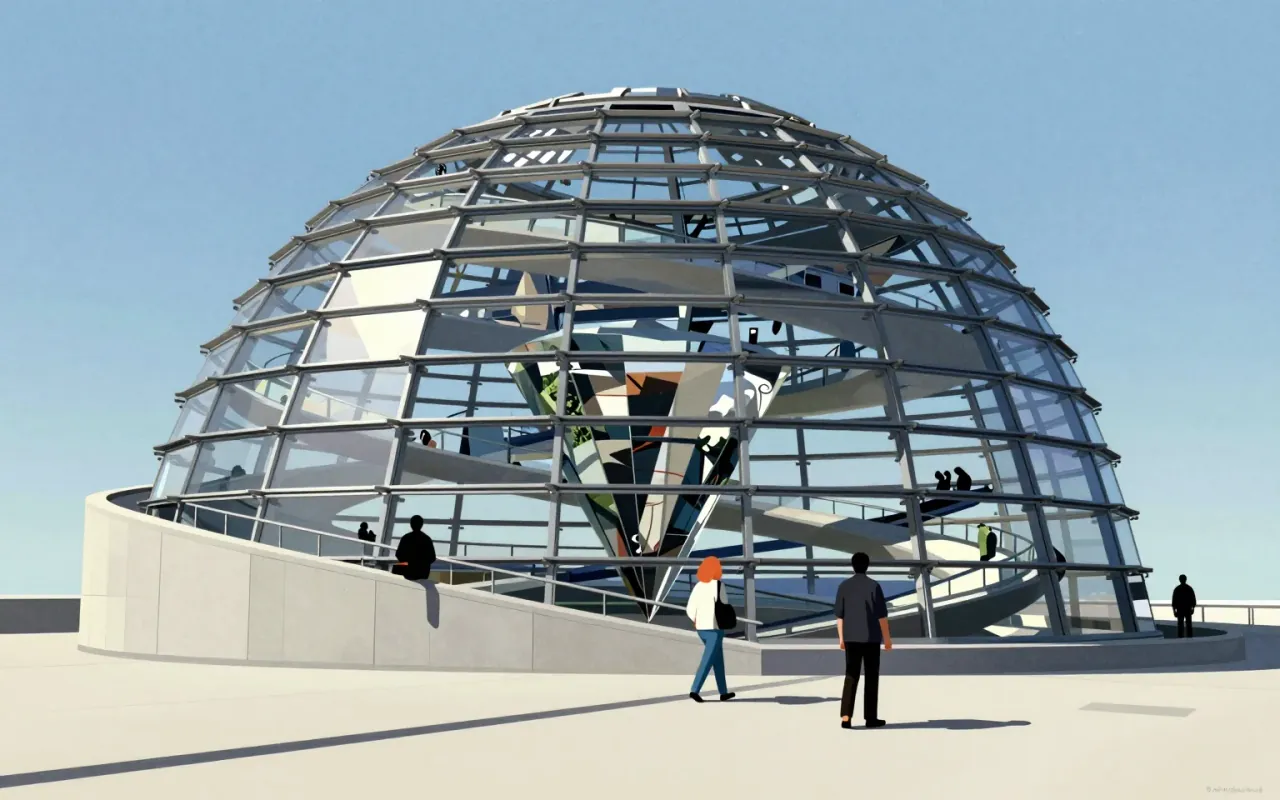
The Reichstag dome is a reconstructed glass structure on the Reichstag building in Berlin. Norman Foster designed it from Gottfried Böhm’s idea. Waagner-Biro built it. It features a mirrored cone, two steel spiral ramps, an electronically tracked sun shield, and daylight-driven energy efficiency. It provides a 360° view of Berlin. It makes the Bundestag chamber visible from above. It symbolises German reunification and democratic transparency.

business.briefs Business

All 1 in business →
9:56

Telemadrid

A public broadcaster that swapped editorial independence for political utility—and paid for it in audience, credibility, and legality.

culture.briefs Culture

All 19 in culture →
9:02

The Overton window

The Overton window is the range of subjects and arguments the mainstream accepts politically at a given time, and it can shift, shrink or expand.
10:03

Intentional community

Intentional communities are not utopian experiments—they are operational laboratories for democracy, income-sharing, and cohabitation under constraint.
8:38

Pirate Party

It turned copyright outrage into a party—but never solved how to govern the internet.
9:04

Campaign advertising

Campaign advertising isn’t about democracy—it’s about control of attention, and the rules governing it are already broken.