briefs
Topic · across the network

The Belle Epoque

Europe's last long peace, remembered mostly because of what came next.

13
briefs
2
subjects
12:37
average
164 min
in total
Abstraction 407Absurdism 137Acoustics 220Acting 65Adaptation 372Addiction 95Adolescence 202Advertising 77Age of exploration 14Ageing 113Agriculture 100Algorithms 114Ambition 46Anarchism 38Ancient Egypt 17Ancient Greece 38Ancient Rome 30Animals 172Anthropology 23Apartheid 12Architecture 165Archives 32Argentina 10Art Deco 26Artificial intelligence 78Astronomy 81Attention 42Australia 32Automation 73Avant-garde 164Aviation 79Banking 72Banned works 40Bauhaus 12Beer 5Behavioural economics 22Berlin 16Big tech 6Biodiversity 136Biography 86Birds 41Black holes 20Blockchain 12Boxing 14Branding 77Brazil 43Bread 29Britain 131Brutalism 4Bubbles 3Buddhism 28Byzantium 10California 17Canada 18Capitalism 94Cars 468Celebrity 59Censorship 110Cheese 24Chefs 9Chemistry 104Chess 2Childhood 87China 109Chocolate 8Christianity 49Cinematography 343Cities 90Class 485Climate change 107Club culture 100Cocktails 2Coffee 11Cognitive bias 14Collecting 16Colonialism 284Colour 42Comedy 89Community 52Complexity 21Computing 309Consciousness 16Conservatism 14Conspiracy theories 8Cooking 178Corruption 38Cosmology 31Cover versions 64Craft 116Crate digging 42Creativity 8Crime 234Cryptocurrency 8Cryptography 24Cuba 10Cybersecurity 30Dada 12Debt 38Decision-making 28Decolonisation 46Deep time 80Democracy 45Denim 16Deserts 45Detroit 17Dinosaurs 12Directing 168Disasters 59Disease 109DJ culture 89Dreams 32Drones 5Drum machines 96Dystopia 69East Africa 28Ecology 337Economics 36Editing 72Education 92Egypt 12Electric vehicles 59Emotion 22Empire 92Endurance 49Energy 120Engineering 541Entropy 8Epidemics 13Equality 9Espionage 31Ethics 44Evolution 174Existentialism 106Expertise 2Exploration 49Extinction 23Failure 37Family 240Fandom 22Fascism 45Fashion 215Fast fashion 12Fear 34Feminism 122Fermentation 126Film music 81Fishing 12Folklore 71Food history 588Football 16Forests 31Forgery 7France 163Fraud 15Free will 13Freedom 16French literature 15Friendship 24Furniture 36Gambling 14Gender 63Generations 28Genetics 87Geology 96Germany 66Globalisation 74Gothic 32Greece 5Grief 126Habits 6Happiness 2Hardware 709Haute couture 22Headphones 8Hi-fi 12Hinduism 12Hoaxes 1Human history 23Human nature 41Identity 138Illustration 8Impressionism 6Improvisation 249India 89Indonesia 15Industrial design 342Inequality 13Inflation 4Information 34Infrastructure 280Insects 29Intelligence 8Interiors 31Internet culture 88Invention 329Iran 41Islam 40Islands 17Israel 9Italy 52Jamaica 10Japan 114Jewellery 5Journalism 34Judaism 13Justice 42Korea 41Language 70Law 90Leadership 20Learning 6Liberalism 1Libraries 6Literary criticism 26London 12Loneliness 61Los Angeles 62Lost works 9Love 67Luxury 55Machine learning 15Management 10Maps 5Marketing 21Markets 51Mars 6Marxism 26Masculinity 46Materials 138Mathematics 79Meaning 6Medicine 124Memory 82Mental health 70Mesopotamia 4Mexico 38Migration 95Minimalism 68Mining 30Misinformation 9Modernism 63Money 24Monopoly 32Mortality 61Motivation 2Mountains 16Museums 27Mysticism 11Mythology 60Nationalism 40Neuroscience 23New York 36Nigeria 7Nihilism 10Noise 31Nostalgia 33Nuclear 29Nutrition 17Oceans 48Oil 42Open source 45Painting 18Palaeontology 29Parenting 14Paris 18Partition 6Patents 71Patronage 14Perception 44Personal style 27Personality 2Persuasion 8Peru 10Philosophy 77Photography 37Physics 206Plants 26Platforms 89Podcasting 1Poetry 25Poland 17Policing 34Pop Art 16Populism 2Portraiture 6Portugal 18Postmodernism 23Power 91Prehistory 24Preservation 28Printmaking 21Privacy 11Probability 6Productivity 1Programming 54Prohibition 1Propaganda 35Protest 75Pseudoscience 17Psychology 80Publishing 22Punishment 16Quantum mechanics 44Race 145Radio 30Railways 35Rave 17Realism 47Record labels 19Recording 810Relativity 23Religion 154Resilience 15Restaurants 30Restoration 2Retail 94Revolution 58Risk 18Ritual 96Robotics 26Romance 96Russia 58Salt 9Sampling 246Satire 84Scandinavia 28Scientific method 186Screenwriting 26Sculpture 7Secularism 2Self-deception 14Semiconductors 73Sexuality 102Ships 18Silence 24Silicon Valley 17Slavery 35Sleep 2Smartphones 27Sneakers 15Social media 58Socialism 9Software 68Songwriting 180Sound design 332Sound systems 20South Africa 19South East Asia 30Space exploration 84Spain 18Special effects 41Spices 62Spirits 12Sport 82Startups 21Statistics 10Status 9Stoicism 4Storytelling 68Strategy 70Street food 99Streetwear 16Studio craft 508Subcultures 59Sugar 12Supply chains 115Surrealism 53Surveillance 21Sustainability 30Synthesis 232Tailoring 37Taxation 14Tea 24Textiles 97Thailand 11The American Revolution 19The American South 88The Arab world 41The Arctic 19The Balkans 17The Belle Epoque 13The body 29The brain 26The Caribbean 28The civil rights movement 62The Cold War 160The eighties 268The Enlightenment 29The financial crisis 19The First World War 39The food industry 157The French Revolution 9The Gilded Age 9The Great Depression 18The Holocaust 20The Industrial Revolution 93The internet 61The interwar years 135The Middle Ages 35The Moon 4The music business 169The Netherlands 10The nineties 26The Olympics 10The pandemic 13The Reformation 1The Renaissance 16The Russian Revolution 19The Second World War 102The seventies 58The sixties 28The space race 5The United States 19The universe 7The Victorian era 37Therapy 20Tokyo 11Trade 48Tragedy 22Translation 5Trauma 85Travel 5True crime 2Turkey 18Typography 54Uniforms 23Unions 8Urban planning 66Utilitarianism 1Utopia 5Vaccines 10Vegetarianism 15Venture capital 6Video games 291Vietnam 12Vintage 65Vinyl 6Virtual reality 11War 169Watches 4Water 11Weather 29West Africa 29Wilderness 10Wine 3Work 22Workwear 19Worldbuilding 121

film.briefs Film

All 12 in film →
13:00

And the Ship Sails On

Federico Fellini · 1983

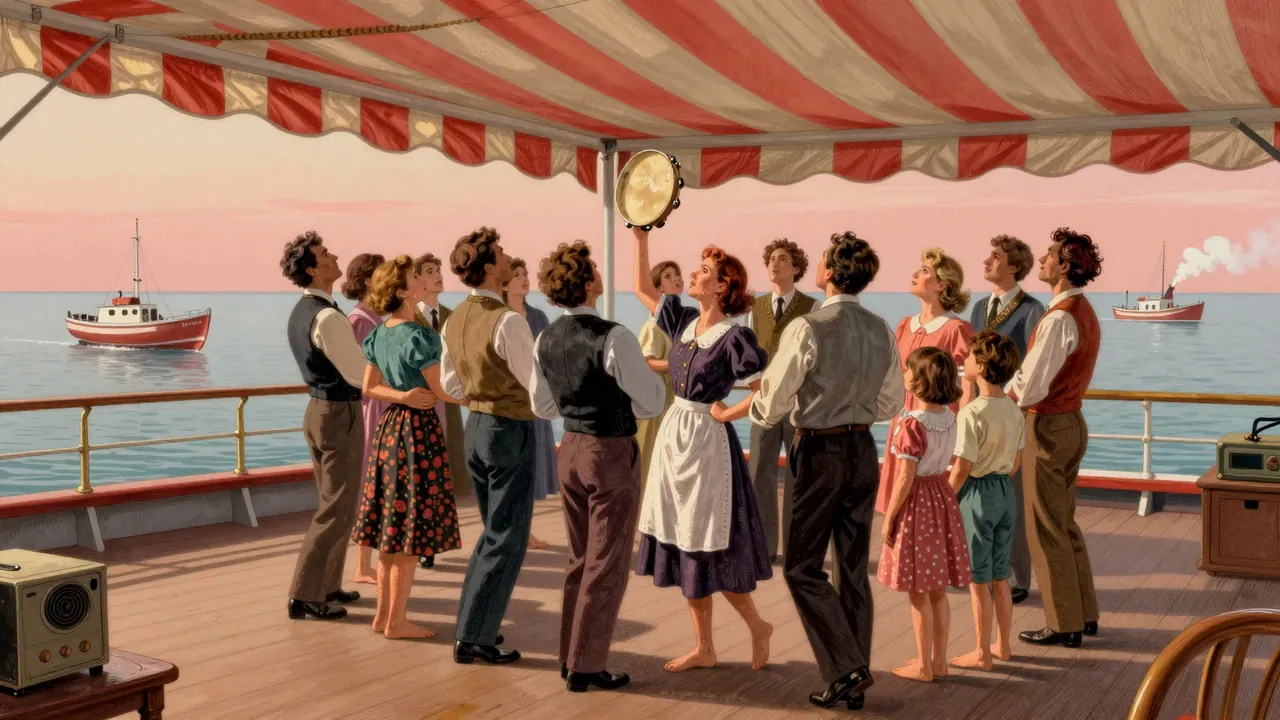
Set aboard the luxury liner Gloria N. in July 1914, Federico Fellini’s And the Ship Sails On follows a funeral voyage to scatter the ashes of a legendary opera singer. Through journalist Orlando’s wry narration, the film assembles a gallery of caricatured aristocrats, artists, and dignitaries — all performing grief, status, and obsession aboard a vessel that doubles as a stage, museum, and mausoleum. Giuseppe Rotunno’s cinematography and Dante Ferretti’s sets sustain a lush, theatrical artifice, while Gianfranco Plenizio’s score underscores the film’s blend of grandeur and gentle absurdity. The voyage ends not with resolution but with sinking — literal and metaphorical — as the ship founders amid cannon fire and butterflies.
13:00

Casque d'Or

Jacques Becker · 1952

Jacques Becker’s 1952 drama follows Marie and Manda, lovers caught in the violent hierarchies of Belle Époque Paris. Shot with precise, unadorned realism, it avoids moralising or spectacle, instead anchoring emotion in gesture, setting, and consequence. Simone Signoret and Serge Reggiani deliver performances of quiet intensity, supported by Robert Lefebvre’s understated cinematography and Marguerite Renoir’s taut editing. Its final sequence — Marie watching Manda’s execution from a hotel window — remains one of cinema’s most devastating uses of spatial restraint.

13:00

Elena and Her Men

Jean Renoir · 1956

Jean Renoir’s 1956 film follows a Polish princess in fin de siècle Paris whose romantic entanglements intersect with a general’s wavering ambition and a shoe magnate’s calculations. Shot in Paris studios and locations, with design by Jean André and music by Joseph Kosma, it treats politics as theatre and desire as strategy — light in tone, precise in execution, and deliberately unmoored from psychological realism.

13:00

French Cancan

Jean Renoir · 1955

Jean Renoir’s 1955 French Cancan follows nightclub owner Henri Danglard as he transforms a Montmartre dance hall into the Moulin Rouge, betting everything on the revival of the cancan. Starring Jean Gabin and Françoise Arnoul, it is a musical comedy-drama less concerned with plot than with the textures of creation: rehearsal, construction, rivalry, and collective euphoria. Shot in colour at Joinville Studios with art direction by Max Douy and cinematography by Michel Kelber, it evokes Impressionist painting without imitation. Though uneven in emotional payoff, it remains a singular testament to Renoir’s belief in cinema as a space for presence, not just meaning.

13:00

Heaven Can Wait

Ernst Lubitsch · 1943

Ernst Lubitsch’s 1943 Heaven Can Wait follows Henry Van Cleve, a New York heir who, upon arriving at the reception area of Hell, recounts his life to prove he belongs there. Framed as a wry, non-chronological character study, the film uses fantasy not for spectacle but for structure—tracing seventy years of privilege, marriage, and quiet moral drift with precision, irony, and deep affection for its characters’ limitations.

13:00

Love Story

Claude Autant-Lara · 1943

Set in late-nineteenth-century France, Claude Autant-Lara’s Love Story (Douce) follows Douce de Bonafé, a sheltered heiress whose quiet affection for the estate manager Fabien collides with her governess Irène’s ambition. When Irène pursues Fabien — and then Douce’s widowed father — the household’s fragile equilibrium fractures. With restrained performances, Philippe Agostini’s subdued cinematography, and a script that trusts silence over exposition, the film traces how inherited structures of class and gender compress desire into inevitability. Its tragedy is understated, its pacing unhurried, its moral landscape deliberately unresolved.

13:00

Mayerling

Anatole Litvak · 1936

Anatole Litvak’s 1936 Mayerling is a French historical drama starring Charles Boyer and Danielle Darrieux, adapted from Claude Anet’s novel Idyll’s End. Set in late-19th-century Vienna, it traces Crown Prince Rudolf’s estrangement from duty and his fatal relationship with Baroness Marie Vetsera. Shot in restrained, underlit interiors by Armand Thirard and scored by Honegger, Jaubert and Tchaikovsky, the film avoids melodrama in favour of cumulative emotional weight. Though criticised in 1936 for its muted politics and ambiguous ending, its coherence, precision and formal discipline make it a distinctive artefact of interwar European arthouse cinema.

13:00

Smiles of a Summer Night

Ingmar Bergman · 1955

Set over one Midsummer Night in early-twentieth-century Sweden, Ingmar Bergman’s Smiles of a Summer Night traces shifting affections among lawyers, actresses, counts and servants. Shot by Gunnar Fischer and scored by Erik Nordgren, it balances theatrical structure with emotional nuance, using wit and restraint rather than exposition or psychology to resolve its tangles. It is a film about how love negotiates time, class and habit — not revelation, but recalibration.

design.briefs Design

All 1 in design →
8:04

Art Nouveau

Art Nouveau didn’t invent new forms — it weaponised natural curves to dissolve the hierarchy between art and craft.