Ho Chi Minh
1945
A tightly sourced, action-focused account of Ho Chi Minh’s documented political output — no speculation, no omission of violence, no celebration without evidence.
The country the world knows as a war, and everything that came before and after it.
A tightly sourced, action-focused account of Ho Chi Minh’s documented political output — no speculation, no omission of violence, no celebration without evidence.
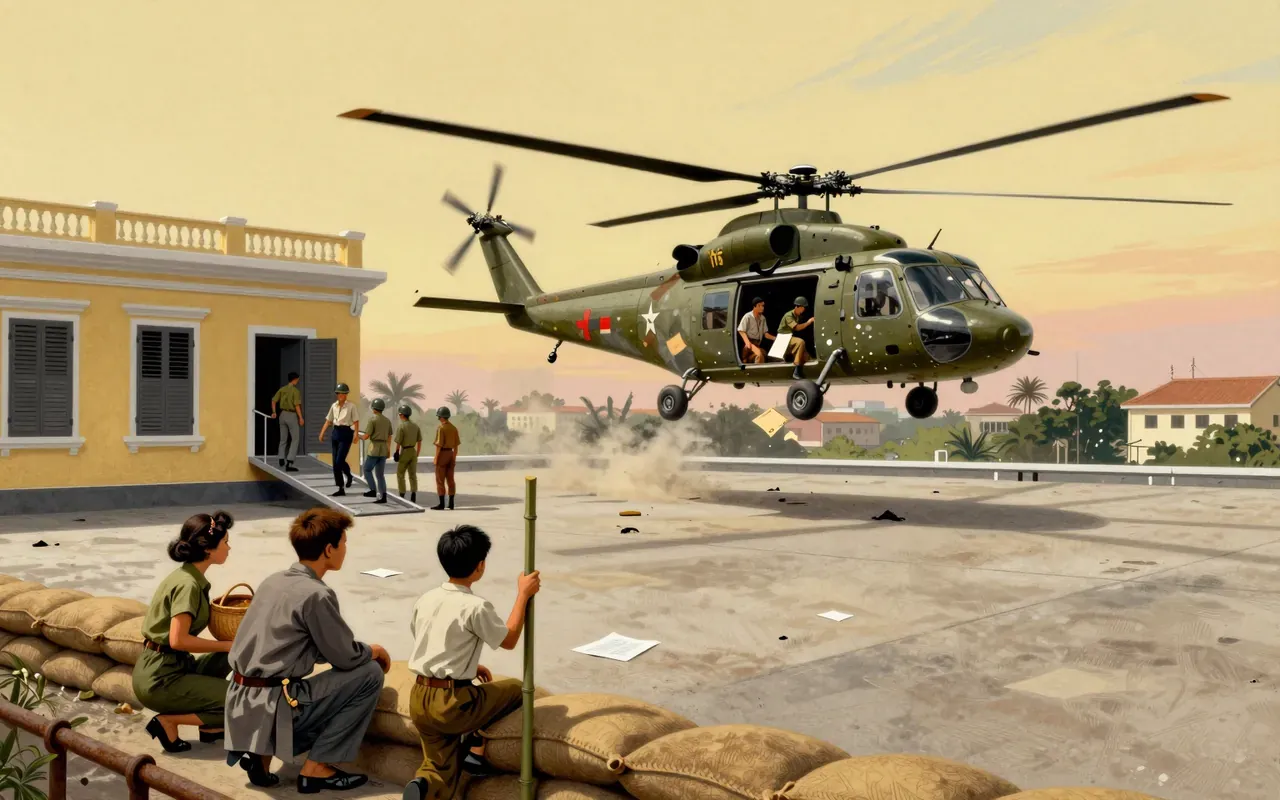
The Fall of Saigon was the conclusive military event of the Vietnam War: North Vietnam captured the city on 30 April 1975, dissolving South Vietnam and unifying the country under one regime for the first time since 1954. Its speed and finality stemmed from the prior U.S. withdrawal and ARVN’s rapid disintegration — not battlefield indecision or last-minute diplomacy. The record is clear on what happened, when, and who carried it out. What remains outside the source — casualty figures, refugee totals, internal debates — stays contested.

In 938, the Vietnamese general Ngo Quyen ended roughly a millennium of Chinese administrative control by luring a Southern Han invasion fleet onto iron-tipped stakes concealed in the Bach Dang River, then attacking as the tide dropped and stranded the ships. What survives of the battle comes largely from near-contemporary Chinese chronicles and much later Vietnamese legendary collections written for nation-building purposes. Ngo Quyen proclaimed himself king the following spring, though his own dynasty collapsed into succession disputes within decades.

Fought from the mid-1950s to 1975 between communist North Vietnam and the American-backed south, the Vietnam War grew out of the unresolved partition that followed France's defeat in Indochina. It drew in the Soviet Union, China and a coalition of American allies, produced casualty estimates that vary by hundreds of thousands depending on methodology, and ended with North Vietnam's victory, reunification, and a war whose spillover into Cambodia and Laos killed hundreds of thousands more.