Do Androids Dream of Electric Sheep?
Dick's 1968 novel sets up the century's central question about AI and consciousness. The brief covers Deckard's hunt for androids, the problem of empathy, and why the book never settles the question it asks.
The field that has been five years away for seventy years, and then was not.

Dick's 1968 novel sets up the century's central question about AI and consciousness. The brief covers Deckard's hunt for androids, the problem of empathy, and why the book never settles the question it asks.

Gibson's 1984 debut defined cyberpunk and coined the term 'cyberspace' before the internet existed. The brief covers the heist plot in five minutes, the AIs in five more, and why everyone building the future still treats this as a founding text.

Yoshimi Battles the Pink Robots is a 2002 electronic pop record that foregrounds texture over narrative, borrowing melody while avoiding resolution. Its ideas land where its sound does — in the space between acoustic warmth and digital precision.

Jean-Luc Godard’s 1965 Alphaville transplants American detective Lemmy Caution into a nameless, near-future city ruled by Alpha 60, a sentient computer that bans emotion, poetry, and questioning. Shot on real Paris locations with no futuristic props, it merges film noir and dystopian satire to interrogate language, control, and the persistence of feeling. Eddie Constantine and Anna Karina star; Raoul Coutard shot it, Agnès Guillemot edited it, Paul Misraki scored it. It won the Golden Bear at Berlin in 1965.

Takashi Murakami’s 2013 debut feature Jellyfish Eyes is a Japanese science-fiction drama about a grieving boy who befriends a jellyfish-like creature in a town where children pilot digital companions called F.R.I.E.N.D.s. Directed with painterly stillness and scored with bright, synthetic music, it explores childhood vulnerability, institutional opacity, and the ethics of creation — not through exposition but through texture, silence, and recurring visual motifs. Though its narrative structure falters and its genre elements remain underdeveloped, its emotional precision and conceptual consistency give it a quiet, cumulative power.

Bertrand Bonello’s The Beast follows Gabrielle across three lifetimes — 1910 Paris, 2014 Los Angeles, and 2044, where AI mandates emotional purification — to trace how dread and desire recur as physiological patterns, not psychological choices. Léa Seydoux and George MacKay anchor a formally precise, emotionally austere film that refuses catharsis in favour of cumulative resonance.

David Cronenberg’s 2024 film *The Shrouds* follows a widowed inventor who develops ‘GraveTech’, a technology that broadcasts live 3D images of decomposing corpses via modified shrouds. Set in Toronto and conceived as a response to the director’s own bereavement, the film explores grief as a physical, technological, and architectural condition — one that can be hacked, misrendered, and eroticised. With Vincent Cassel, Diane Kruger, and Guy Pearce, it sustains a tone of clinical unease, privileging conceptual rigour over narrative resolution.

A quietly devastating science fiction drama in which a family attempts to repair their malfunctioning android son, uncovering layers of memory, loss, and care. Set in a calm, unspecified future, it avoids genre spectacle in favour of domestic intimacy, using restraint as both aesthetic and ethical principle.


Geoffrey Hinton and colleagues established core methods—backpropagation for representation learning, and Boltzmann machines for unsupervised deep generative modelling—between 1985 and 1995. Their work was grounded in statistical mechanics, experimentally verified on small-scale networks, and explicitly recognised as foundational for machine learning with artificial neural networks. It did not deliver production AI, nor claim to.


The Turing test is a precise, behaviour-first redefinition of intelligence—not proof of thought, but a standard for functional equivalence in dialogue. It endures because it is simple, testable, and ruthlessly limited.


F.E.A.R. is a first-person shooter psychological horror game developed by Monolith Productions in Kirkland, Washington. It uses the studio’s LithTech engine and centres on reflex time, adaptive AI, and melee as a core combat pillar.

Metal Gear Solid 2: Sons of Liberty is a PlayStation 2 stealth-action game released in 2001 by Konami. It features two narrative chapters—the 'Tanker' prologue with Solid Snake and the 'Plant' main section with Raiden—set near New York City in an alternate-history timeline. Its stealth loop relies on observation, environmental interaction, and squad-based enemy AI. It explores memetics, information control, and freedom of thought through a postmodern, fourth-wall-breaking structure.

Tom Clancy's Splinter Cell: Chaos Theory is a 2005 stealth action game developed by Ubisoft Montreal. It refines the series' core stealth loop around two interdependent detection systems: light exposure and relative noise. Guards react intelligently to environmental changes and coordinate tactically. Alarms trigger only on discovery—not on being seen—and no longer cause automatic failure. It expands close-quarters options and introduces equipment loadouts tied to lethality constraints.

Thief: The Dark Project is a 1998 stealth game by Looking Glass Studios. It uses light and sound as core mechanics. Players assume the role of Garrett in a first-person, unscripted 3D world. Objectives are discrete—like stealing a specific object—and must be completed to advance. A visibility gem on the HUD indicates detectability. NPCs react to environmental cues. Eidos Interactive published it.

The Sims is a social simulation video game developed by Maxis and published by Electronic Arts in 2000. Designed by Will Wright, it allows players to create and control virtual people called Sims, build and furnish homes, and manage Sims' needs, relationships, careers, and household finances. Its open-ended gameplay has no fixed win condition. The Sims is an artificial life game built around simulated characters who respond to needs, objects, and other Sims. Although Sims can act autonomously when free will is enabled, the player usually directs their actions, manages their household, and decides how they develop relationships, skills, careers, and homes. Because the game has no fixed win condition, it can be played indefinitely and has been described as more like a toy than a traditional game. Sims are influenced by the player to interact with objects or other Sims. If enabled in the game's options, Sims have a certain amount of free will, allowing them to autonomously interact with their world; however, the player can override most of these autonomous actions by canceling them in the action queue at the top of the screen.


AI: The Somnium Files is a branching adventure game developed by Spike Chunsoft in 2019. It alternates between first-person investigation and timed third-person dream exploration ('Somnium'). Players use an AI assistant named Aiba to analyse scenes and augment vision. Progress requires completing multiple routes via a flowchart, with each route withholding key narrative information until all are finished.


Left 4 Dead is a cooperative first-person shooter released in 2008 by Valve. Players control one of four survivors navigating zombie-infested environments to reach safe areas. Its defining feature is the AI Director, which dynamically adjusts enemy spawns and item placements to ensure varied, tension-filled experiences across playthroughs. Cooperation is structurally enforced via mechanics like wall-visible teammate outlines, shared healing, mandatory revival from incapacitation, and lethal consequences for repeated failure to recover. Campaign mode includes safehouse checkpoints, crescendo events, and defensive finales, while multiple modes (Versus, Survival, Single-Player) extend replayability. The game uses the Source engine and emphasizes cinematic, film-inspired presentation and communication systems — including voice callouts and visual cues — to sustain coordinated group action.

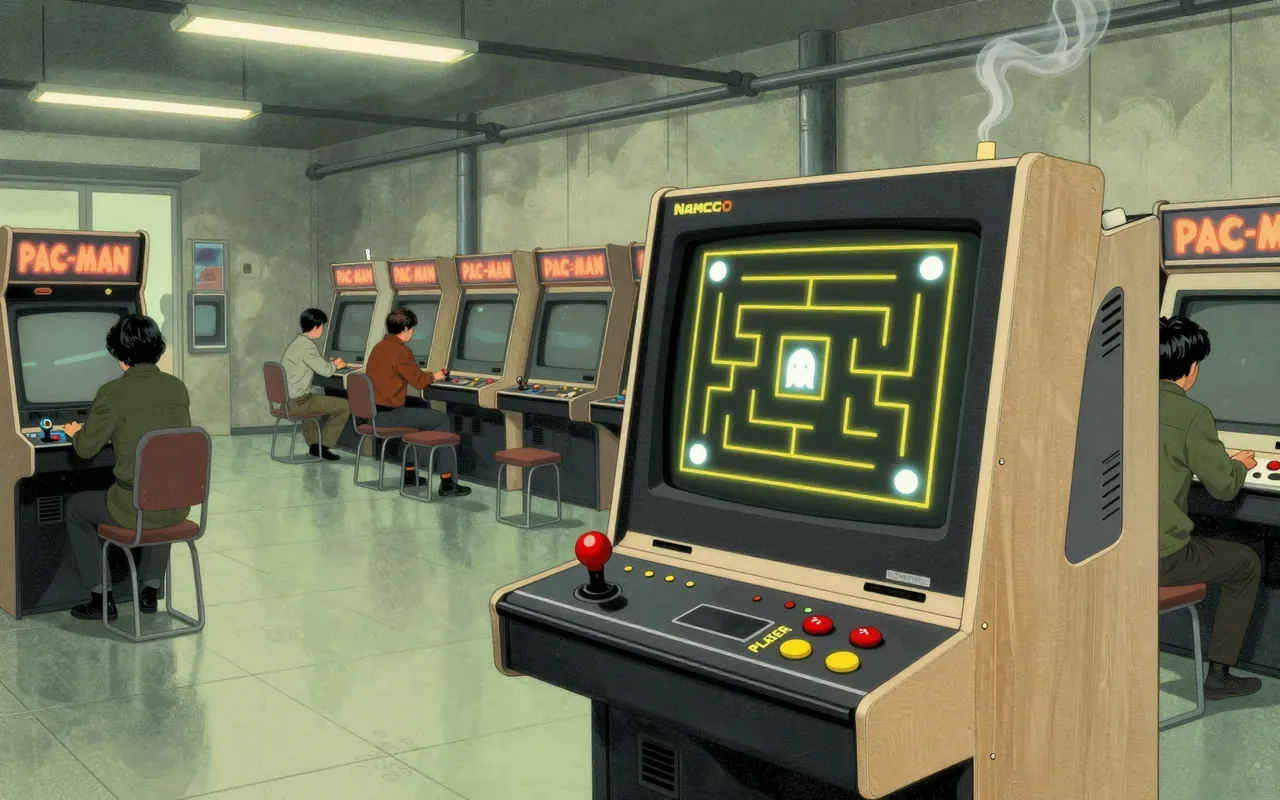
Pac-Man is a foundational arcade game released by Namco in Japan in 1980 (test-marketed 22 May, wide release July) and North America in November 1980. Its design centres on eating dots in a fixed maze while evading four ghosts—Blinky, Pinky, Inky, and Clyde—each governed by a distinct AI rule. Power pellets temporarily reverse ghost behaviour and enable Pac-Man to consume them. Completion of each level requires clearing all dots; contact with a ghost costs a life. The game ends when all lives are lost.

Google DeepMind is a research lab, not a business. Its value lies in its ability to produce peer-recognised scientific milestones — not revenue, not IP licensing, not product deployment. It proves that one company can fund high-risk, long-horizon AI research at industrial scale — but only by insulating it entirely from market logic.


Baidu is a foundational case of algorithm-first platform building: its 1996 RankDex technology became its 2000 product, its 2001 ad model predated Google’s, and its 2003 content-search innovations were tailored to Chinese media structures. It achieved national dominance and NASDAQ listing — but never decoupled from search advertising, even as it invested in Apollo, Xiaodu, and AI stacks.